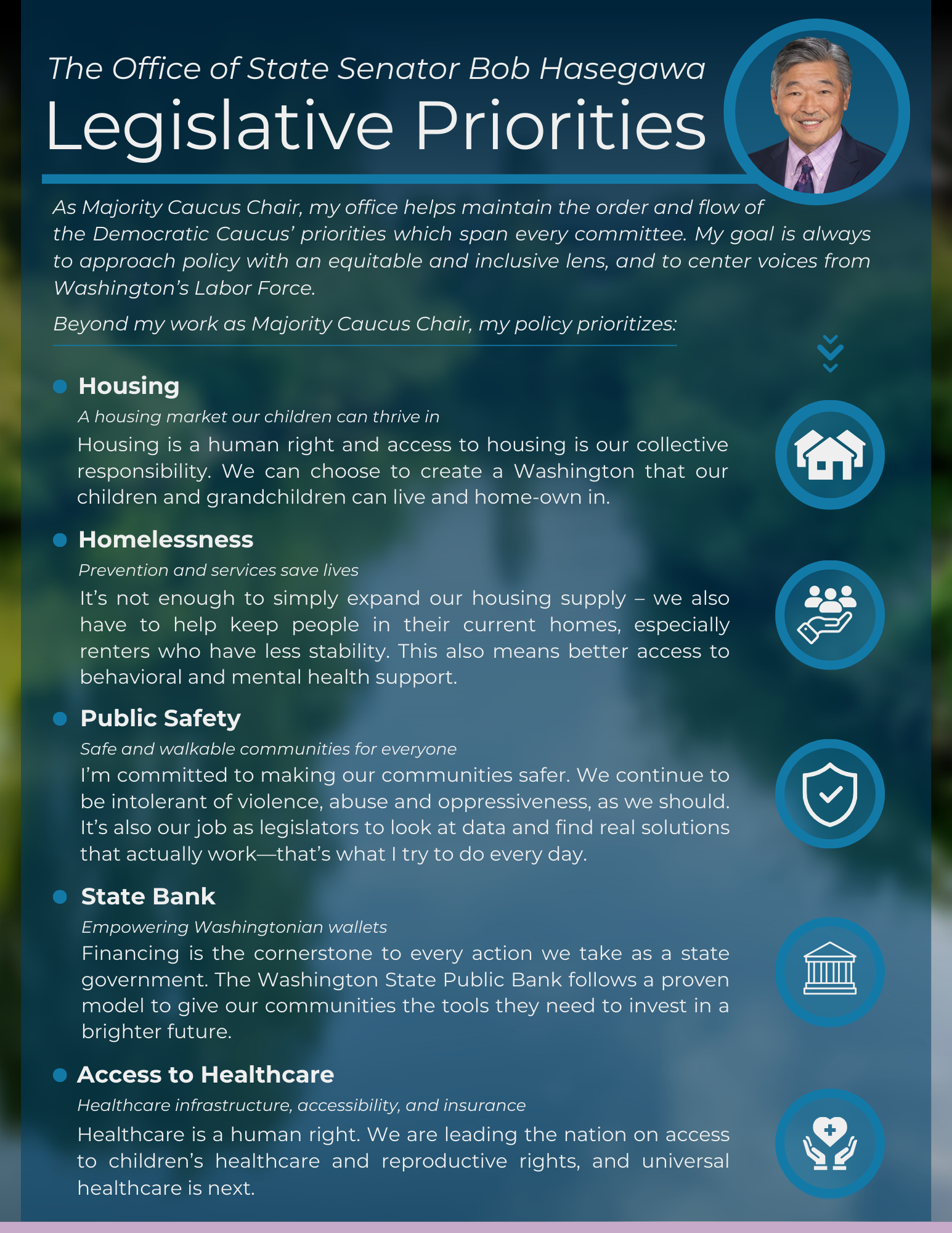
Public Bank Information
A Washington State Bank – Because Your Tax Dollars Should Work For You, Not Wall Street
One of the most important policies I’ve worked on over the past several years is creating a Washington state bank – an idea that would ensure that our tax dollars go to work for us here in Washington, rather than paying interest to big banks on Wall Street.
This year, Washington will pay about $3 billion in debt service to the Wall Street lenders that our state borrows money from, for our capital budget and infrastructure projects. Our local governments – cities, counties, and ports – pay even more. What if instead of paying that money to massive Wall Street banks, we could borrow the money from ourselves, pay it back to ourselves, and reinvest all our tax dollars in Washington?
We’re talking about a bank owned by “We, the People.” Most highly developed countries in the world use public banks to finance public infrastructure and public good. Unfortunately, here in the US we use commercial banks to finance public infrastructure. However, there is one exception in the US—the Bank of North Dakota. Our proposal is along the same lines as the successful Bank of North Dakota, which has successfully implemented its economic development and public support mission for over a hundred years.
A Washington state bank would operate like any other bank – it would hold money (our tax revenue) as deposits and use those deposits to back loans that it makes. The difference is that the customers would be our own state and local governments. Government bank accounts would act as the deposit backing for the loans, and the loans would go out to the state, cities, and counties for the infrastructure investments that we need to make on behalf of our constituents.
What does this mean in practice?
- Lower-cost loans for infrastructure projects – since it’s the state’s own bank, we could get better interest rates for our infrastructure investments. That’s fiscally responsible, and it means each dollar goes further when we’re building schools, affordable housing, roads and highways, high speed rail, water/sewer/irrigation systems, energy transmission lines, telecom connectivity, building a green economy, and everything else important that we do.
- Profits go to the people of our state, not to Wall Street – the profits that the bank would make wouldn’t go to bonuses for Wall Street billionaires, it would come back to the people of Washington. When the Washington state bank makes a profit (the Bank of North Dakota had 16 consecutive years of record-breaking profits every year leading up to the pandemic), all that money is ours to spend on education, affordable housing, tax refunds for working families, and all our other important budget priorities in lieu of taxes, and it would create thousands of jobs.
So why hasn’t this happened yet? Big banks, bond brokers, and their lobbyists are absolutely terrified of this idea. They want to make sure that we’re borrowing money from them, not reinvesting our tax dollars back in our own people. Big money wields big power, usually behind the scenes, but also in disinformation campaigns raising false concerns about public banking, which is a proven strategy throughout the world, and in North Dakota. Our citizen movement to turn this obsolete and oppressive financial system around has a big hill to climb. I’m committed to continuing this work, though, and will continue educating the people, and my colleagues, about how this fiscally responsible idea would work better for the people of our state.
Here are a couple links to learn more about this idea:
Sparkassen-Finanzgruppe (Germany)
National Infrastructure Bank (a public bank proposal for the US; also see SJM 8001)